Piezo vs. Solenoid Diesel Injectors: How Each Works and Why It Matters
Every common-rail injector does the same job — take fuel at rail pressure and deliver a precisely metered spray into the cylinder at exactly the right moment. But there are two fundamentally different ways of actuating the nozzle needle, and knowing which one your engine uses matters when you're diagnosing or replacing injectors.
Solenoid injectors: the workhorse
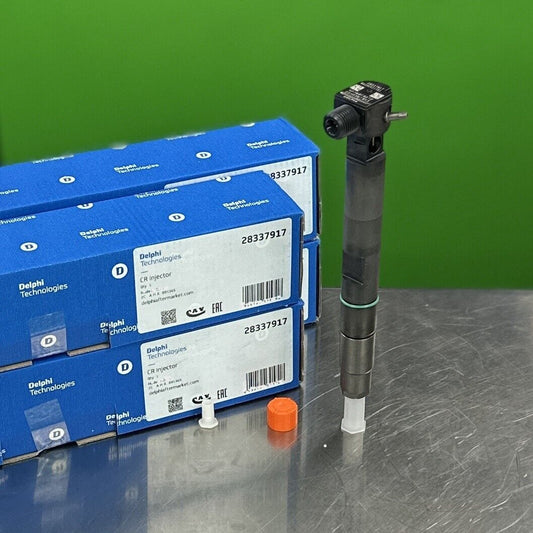
A solenoid injector (Bosch's CRIN family for commercial engines, CRI for cars) controls the nozzle needle with a fast-switching electromagnetic valve. The ECU energizes the coil, the valve shifts, and pressure balance across the needle changes — lifting it so fuel injects directly into the chamber.
Modern solenoid injectors are far from crude. Bosch's current CRIN generation runs at rail pressures of 1,800–2,500 bar, serves engines up to 850 kW (about 1,140 hp), delivers multiple injection events per cycle, and uses a leakless design that gives engineers wide freedom in shaping the injection rate. Solenoid designs dominate medium- and heavy-duty trucks and off-highway equipment because they're robust, tolerant of varying fuel quality, and built for long service life.
Piezo injectors: speed and precision
A piezo injector (Bosch CRI3) replaces the solenoid with a stack of several hundred piezo-ceramic layers. Apply voltage and the ceramic expands a few thousandths of a millimeter — enough, through the actuator-to-needle coupling, to move the nozzle needle almost instantly.
That near-instant response is the whole point. A CRI3 can fire up to 10 individual injection events per combustion cycle at pressures up to 2,700 bar, with extremely small pilot-injection quantities. The result is quieter combustion, lower emissions, and finer control of the burn. Because the actuator is integrated in the housing, piezo injectors are also slimmer than solenoid units — useful in tight cylinder heads. You'll find piezo injectors mostly in passenger-car and light-duty diesels where noise and emissions targets are strictest.
Which is "better"?
Neither — they're engineered for different duty. Piezo buys ultimate precision and compactness; solenoid buys durability, fuel-quality tolerance, and lifetime in high-hour applications. That's why a pickup or industrial engine typically runs solenoid injectors while a European luxury diesel runs piezo.
What it means when you replace injectors
The two designs are never interchangeable, and even within one design, injectors are calibrated to a specific application. Match the exact OEM part number (or its documented cross-reference) — not just the engine family. Injector trim codes, nozzle specs, and length all vary.
Before you order: verify the exact injector by OEM cross-reference for your engine.
Browse our fuel injector catalog — we stock both solenoid and piezo types — or send us your part number or engine details via the chat box and we'll confirm the correct unit.
Share